Peoples and dynasties
Mehmed II, the Conqueror: The Sultan Behind the 1480 Portrait
The sultan who took Constantinople at twenty-one, and then sat for a Venetian painter. Mehmed II repopulated a nearly empty city by decree, assembled a library in five languages, and commissioned likenesses of himself at a court where the practice sat awkwardly with religious opinion. He is the only figure in this thousand years whose face is as well known as anything he built.
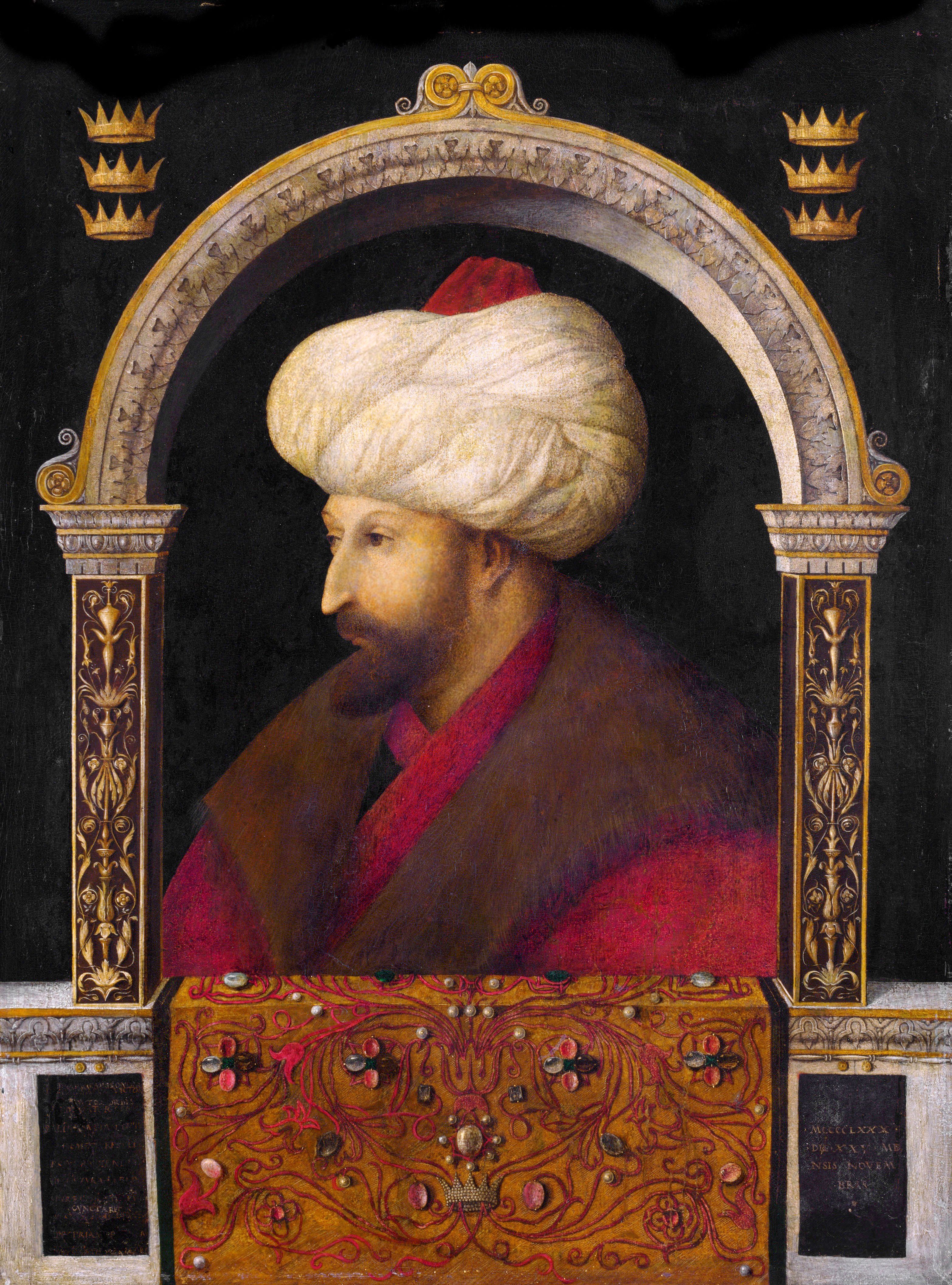
Mehmed II is the most painted Ottoman sultan of the fifteenth century and the least typical. He took Constantinople at twenty-one, moved his court into it, and then spent the rest of his reign behaving in ways that made his own scholars uneasy: importing Italian artists, collecting Greek manuscripts, sitting for a portrait.
The conqueror and the year 1453
The siege lasted fifty-three days. What made it work was not numbers but engineering: a Hungarian founder named Orban cast bombards for the sultan that could bring down curtain walls, and Mehmed had ships dragged overland into the Golden Horn to get around the chain across its mouth. The city fell on 29 May 1453.
The title Fatih, the Conqueror, dates from that. What followed matters more for this history. Mehmed II did not treat Constantinople as a prize to be stripped. He repopulated it, deliberately and by decree, moving Greek, Armenian, Jewish and Turkish families in from across the empire. He rebuilt the markets, commissioned a new palace and set out a mosque complex on the site of the Church of the Holy Apostles.
A sultan who read in four languages
The library he assembled contained Greek, Latin, Arabic, Persian and Turkish manuscripts, including Ptolemy's Geography, which he had copied and annotated. He questioned Byzantine scholars about Christian theology. He kept a Venetian painter at his court for over a year.
None of this was neutral. A sultan commissioning a likeness of himself was, to strict opinion at his own court, doing something close to forbidden. Mehmed did it anyway, repeatedly, in paint and in cast bronze medals, and the practice largely stopped after his death. His son Bayezid II is said to have sold off part of the collection.
A city refilled by decree
A survey taken twenty-five years after the conquest counted roughly sixteen thousand households. The population had been moved in deliberately, from Anatolia and the Balkans, and deliberately mixed.
The portrait of 1480
In 1479 Venice and the Ottoman Empire signed a peace after sixteen years of war, and part of the settlement was cultural. The Venetian senate sent Gentile Bellini, one of the two leading painters of the city, to Istanbul. He stayed until early 1481.
The portrait he produced is dated 1480. Mehmed is shown in strict profile-to-three-quarter view under a stone arch, framed by an architectural surround with a jewelled cloth draped over the parapet in front of him. He is thin, hook-nosed and about to turn fifty; he died the following year. The painting is not flattering and does not appear to have been meant to be.
What makes it historically loaded is the format. Bellini painted him the way he would have painted a Venetian patrician: an individual likeness, in a European framing device, with an inscription. The result is a document of a moment when the Ottoman court was willing to be portrayed in someone else's visual language.
What happened to the painting
The picture has had a rough life. It was heavily repainted at some stage, and how much of the surface is Bellini's own hand has been argued over for a century. It left Istanbul at an unknown date, surfaced in the nineteenth century, and is now in London.
Its influence was out of proportion to its condition. Copies, versions and derivations circulated in Europe for three hundred years, and the image of the Ottoman sultan as a specific, sharp-featured individual rather than a generic oriental despot begins here.
The medals, and the other likenesses
Bellini was not the only one. Costanzo da Ferrara, sent from Naples, cast a bronze medal of the sultan showing him in profile on one side and mounted on the other, in the manner of a Roman coin. A second painter, possibly from the same circle, produced a seated portrait. Ottoman court painters made their own versions, and a manuscript image of the sultan smelling a rose, attributed to Sinan Bey or his pupil, adapts the European likeness into a Persianate idiom.
The medals matter as much as the paintings. A medal is a portable, reproducible statement of authority in a format every Italian court recognised, and commissioning one placed Mehmed II inside a European system of princely representation deliberately and on his own terms.
Rebuilding a city that was nearly empty
Constantinople in 1453 held perhaps forty to fifty thousand people, in a walled area built for half a million. Mehmed II treated that as the central problem of his reign and solved it administratively.
He ordered settlement, by decree and by force, moving families from Anatolia and the Balkans into named quarters. He guaranteed the Greek Orthodox patriarchate, appointing Gennadios Scholarios in 1454, and gave the Armenian and Jewish communities their own recognised structures. He rebuilt the covered market, endowed a mosque complex with eight madrasas on the site of the Church of the Holy Apostles, and started the palace that became Topkapi.
By 1478 a survey counted roughly sixteen thousand households. The city had been repopulated in a quarter of a century, and it had been repopulated deliberately mixed.
The library and what was in it
The palace collection Mehmed assembled ran to well over a thousand volumes in Greek, Latin, Arabic, Persian, Hebrew and Turkish. It included Ptolemy's Geography, which he had copied and had annotated with Arabic place names, works of Aristotle and Homer, Byzantine chronicles and Christian theology.
He questioned Greek scholars about doctrine and commissioned George Amiroutzes to work on the Ptolemy. He also collected Italian medals and, on the evidence of the inventories, coins. None of this made him popular with the religious establishment at his own court, and his son Bayezid II reversed much of it, dispersing part of the collection and returning some confiscated endowments.
How Mehmed II fits the thousand years
Every other figure in this history is represented by things they commissioned. Mehmed is represented by a face. That is the anomaly, and it is worth sitting with, because it marks the point at which the Ottoman court stopped being a regional power that occasionally dealt with Europe and became a Mediterranean one that Europe had to deal with.
The imperial style that follows in the sixteenth century, the tile, the silk, the Sinan mosques, is built on the capital he made. The portrait is the first evidence that he knew what he was building.
Common questions
Who was Mehmed II?
The seventh Ottoman sultan, who ruled 1444 to 1446 and again 1451 to 1481, and who captured Constantinople in 1453. He is known as Mehmed the Conqueror.
Who painted the portrait of Mehmed II?
Gentile Bellini, sent from Venice to Istanbul in 1479 as part of the peace settlement between the two states. The painting is dated 1480.
Why is a portrait of an Ottoman sultan unusual?
Figural portraiture of a ruler sat awkwardly with religious opinion at the Ottoman court. Mehmed commissioned likenesses anyway, in paint and on medals, and the practice was largely dropped by his successors.
Where is the portrait now?
In London. The painting left Istanbul at an unrecorded date and reappeared in the nineteenth century; its condition reflects substantial later repainting.