Material culture
Turkish Carpets and Kilims: How They Were Made and How to Read Them
The one part of this material that Europe saw first and understood last. Anatolian carpets appear in Italian and Flemish paintings from the fourteenth century, long before anyone in the west wrote a line about how they were made, and several whole groups are still named after the painters who recorded them.
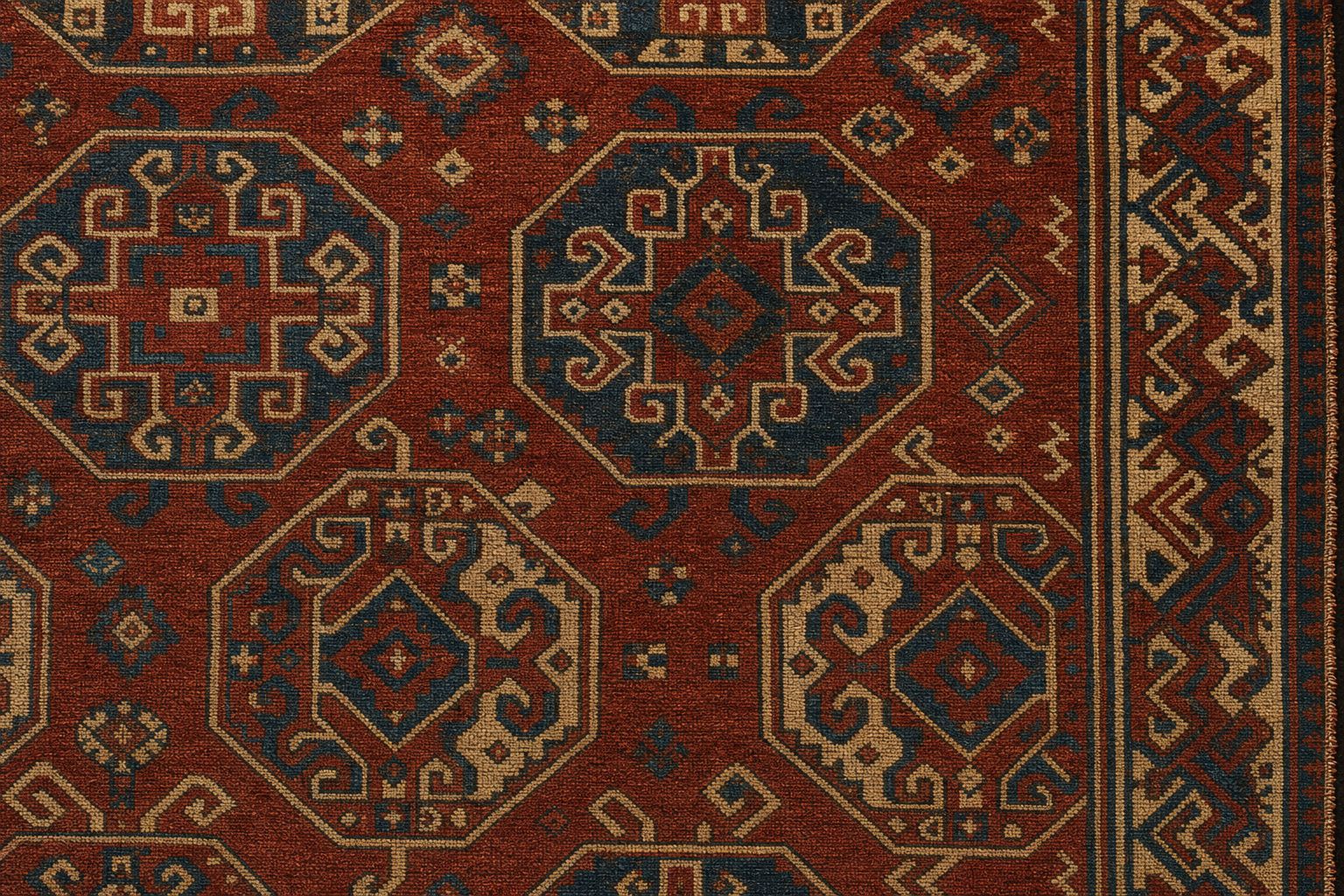
Turkish carpets are the one part of this material that Europe saw first and understood last. They arrive in Italian and Flemish paintings from the fourteenth century onwards, draped over tables and under thrones, long before anyone in the west wrote a line about where they came from or how they were made. Art historians still name whole groups of Anatolian carpets after the painters who recorded them.
How a Turkish carpet is made
The structure is a warp of wool or cotton held on a loom, a weft passed across it, and rows of short pile knots tied by hand between the wefts. The Turkish knot, also called the symmetrical or Ghiordes knot, wraps around two adjacent warps and is pulled down between them. It produces a slightly stiffer, more robust pile than the asymmetrical knot used further east, and it favours the angular, geometric designs that Anatolian weaving is known for.
Knot density is the usual measure of fineness, and it varies enormously: village work might run 400 knots to the square decimetre, a court piece several thousand. Density is not the same as quality. A coarse village rug in good wool with well-mordanted dyes will outlive a fine one made with weak yarn.
Dyes were plant and insect based until the late nineteenth century. Madder root for red, indigo for blue, weld and vine leaf for yellow, walnut husk for brown, and cochineal where it could be afforded. Uneven dye lots produce abrash, the horizontal banding of tone across a field, which is a mark of hand-dyed yarn rather than a defect.
Kilim, cicim and the flatweaves
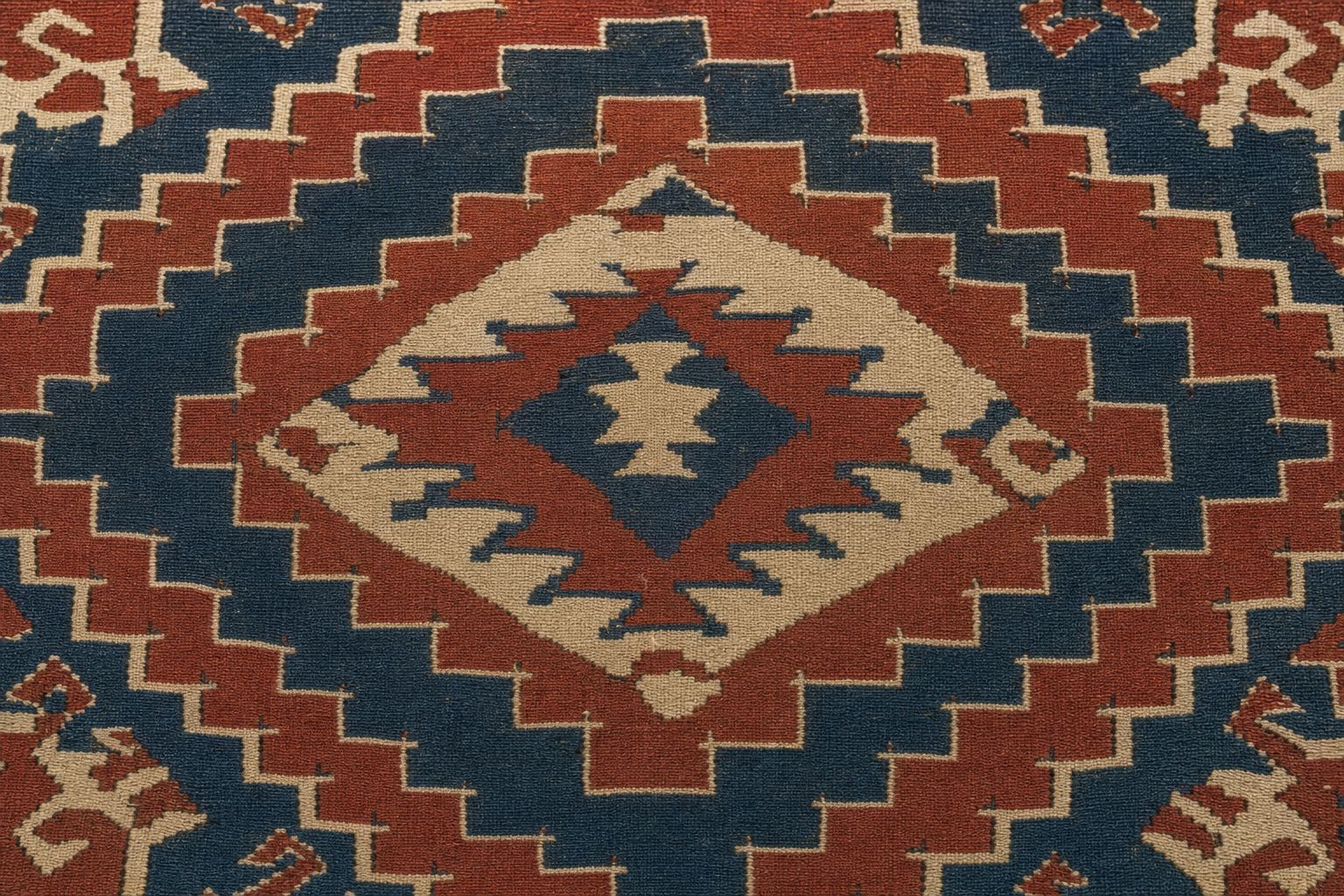
Not every Turkish rug has a pile. The kilim is a flatweave, made by packing the weft tightly over and under the warp so that the weft alone carries the pattern. Where two colour areas meet along a vertical line, the wefts turn back on themselves and leave a slit, which is why kilim designs favour diagonals and stepped forms over straight vertical edges.
Related techniques, cicim, zili and sumak, add supplementary wefts on top of a plain ground to give raised, almost embroidered detail. These were domestic products in a way that pile carpets often were not: cradle covers, salt bags, grain sacks, tent bands, all woven by women in the household for use rather than sale.
The types collectors argue about
| Group | Period | Field design | How it got the name |
|---|---|---|---|
| Animal carpets | 14th-15th c. | Confronted birds and beasts in octagonal compartments | Described from paintings and from a handful of survivals |
| Holbein | 15th-16th c. | Rows of small octagons, or large medallions with interlaced borders | Recorded in portraits by Hans Holbein the Younger |
| Lotto | 16th-17th c. | Yellow arabesque lattice on a red ground | Recorded in paintings by Lorenzo Lotto |
| Ushak medallion | 16th-17th c. | Large central medallion with quarter medallions at the corners | The weaving town of Usak in western Anatolia |
| Ushak star | 16th-17th c. | Repeating eight-pointed stars on a red field | The same town, a different pattern family |
| Transylvanian | 17th c. | Single or double niche with a lamp motif | Preserved in Saxon churches in Transylvania |
| Kilim | throughout | Slit-woven diagonals, stepped medallions, elibelinde motifs | The flatweave technique itself |
Carpets the painters preserved
An Anatolian carpet is rarely dated. A Holbein portrait is. Reading the paintings and the survivals together is how the chronology of Anatolian weaving was built at all.
Carpets in European painting
The Transylvanian group is the clearest case of survival by accident. Anatolian rugs were bought by Saxon merchants, given to Lutheran churches in what is now Romania, hung on the walls and left there. Several hundred survive in those churches, in better condition than anything comparable in Turkey, because a church wall is a gentler place than a floor.
The painted record works the same way. A carpet in a Holbein portrait is dated by the sitter, which gives a fixed point that the carpets themselves rarely carry. Reading the paintings and the survivals together is how the chronology of Anatolian weaving was built at all.
Court carpets and village carpets
From the sixteenth century the Ottoman court commissioned carpets in Cairo and later in Istanbul, using the finer asymmetrical knot and the curvilinear nakkashane vocabulary of saz leaves and rosettes rather than village geometry. These are a different product from the Usak and village work, made for the palace and for diplomacy.
The distinction matters because it maps onto everything else in this history. Court production follows drawings issued centrally; village production follows a pattern held in memory and adjusted by the weaver. Both are Turkish carpets, and they do not look alike.
Prayer rugs and the niche
A prayer rug carries a niche, a pointed arch at one end of the field, oriented towards Mecca in use. The form borrows directly from the mihrab of a mosque wall, and on the finest examples the borrowing is explicit: a hanging lamp, columns supporting the arch, a spandrel filled with the same floral vocabulary as a tiled panel.
The niche is the single most portable piece of architecture in this whole account. It appears in tile, in stone, in book illumination and in wool, and it means the same thing in each.
Common questions
What is the difference between a Turkish and a Persian knot?
The Turkish or symmetrical knot wraps around two warps and is pulled down between them; the Persian or asymmetrical knot wraps one warp and passes behind the other. The Turkish knot gives a firmer pile and suits angular geometric design.
What is a kilim?
A flatweave with no pile, where the weft carries the whole pattern. Where two colours meet on a vertical line the technique leaves a slit, which is why kilim designs are built from diagonals and steps.
Why are carpet groups named after European painters?
Because the paintings are dated and the carpets usually are not. Holbein and Lotto recorded specific Anatolian types so precisely that their names became the standard labels for those groups.
What is abrash?
Horizontal banding of colour across a field, caused by a change of dye lot during weaving. It is evidence of hand-dyed yarn rather than a flaw.