Peoples and dynasties
Storm on Horseback: An Introduction to the Turks, 600 to 1600
One word, a thousand years and four thousand kilometres. A short guide to what it covers, what the sources will and will not tell you, and the three habits of surface, pattern and constructed geometry that hold the whole span together across three religions and half a continent.
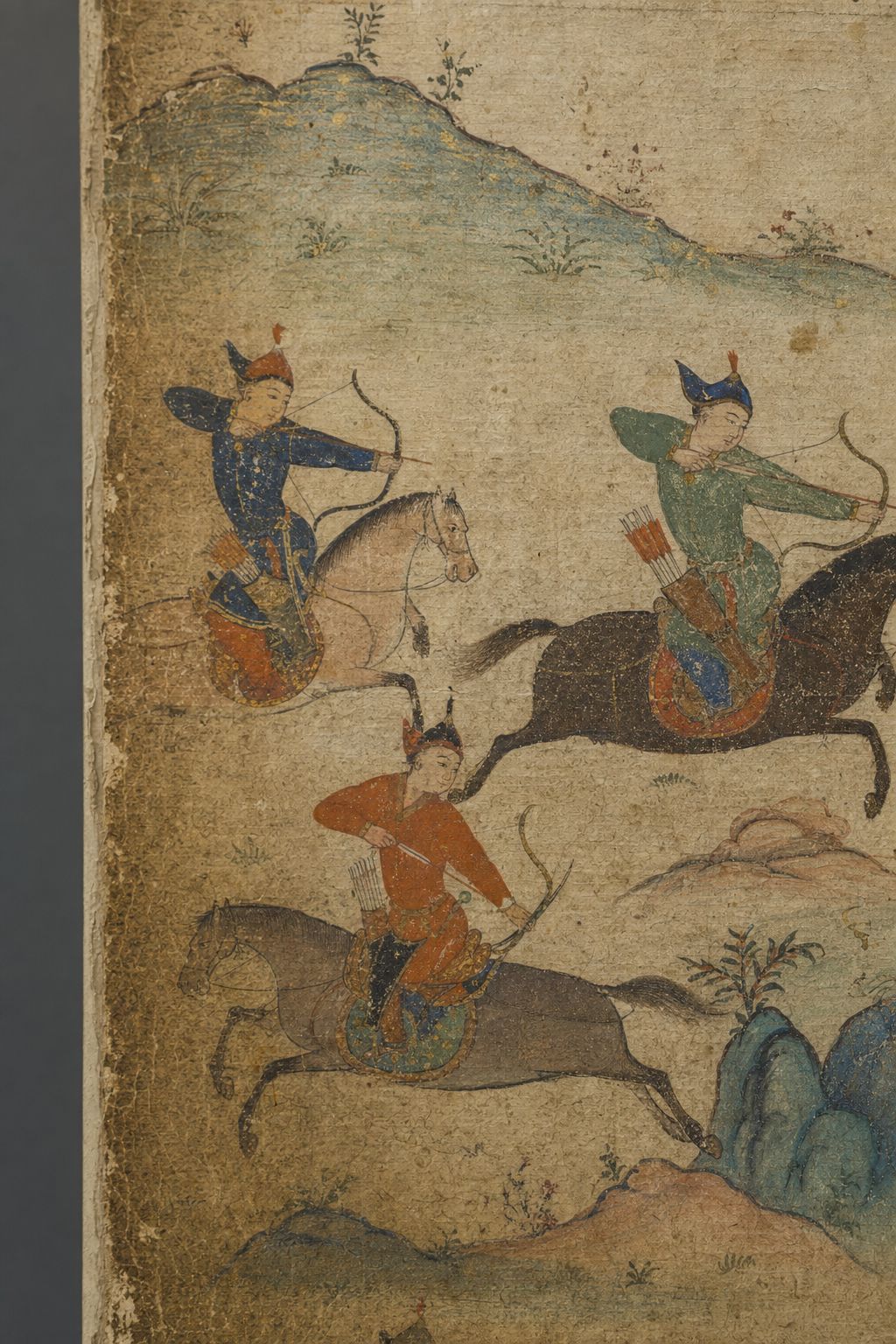
An introduction to the Turks has to begin by admitting how much the word is being asked to do. Over the thousand years covered here it names steppe nomads in Mongolia, oasis merchants in the Taklamakan, sultans in Baghdad, painters in Herat and an imperial bureaucracy in Istanbul. What holds it together is a language family and, more loosely, a set of inherited preferences about how a surface should look.
Where the name comes from
Turk appears in Chinese sources in the sixth century as the name of a confederation on the eastern steppe. The Orkhon inscriptions of the 730s use it of themselves. From there it spreads west with the people who carried it, and by the eleventh century it is being used in Baghdad and Constantinople for populations several thousand kilometres from the Orkhon.
The steppe inheritance
Life on the grasslands set the terms for everything that came after. Wealth was in animals and had to move; therefore objects were portable, and the most sophisticated craft went into things that could be carried or worn. Belt fittings, horse harness, weapons, felt and leather. Almost none of the textile survives, which distorts the record badly.
The other inheritance is political. Steppe confederations were held together by a ruling family whose members all had a claim, which made them formidable in expansion and fragile in succession. Both the Seljuk and the early Ottoman states show the pattern.
Storm on horseback
The phrase belongs to the sources of the settled world, which described Turkic arrival in exactly those terms. It is worth treating with care. The military reputation was earned, and the mounted archer was genuinely difficult to counter. But the same peoples spent most of their history trading, farming, endowing colleges and running tax systems, and the storm metaphor has done a lot of work over the centuries in obscuring that.
Conversion and continuity
Turkic peoples were Tengrist, Manichaean, Buddhist and Christian before large-scale conversion to Islam from the tenth century onwards. The conversion changed patronage, architecture and the acceptable range of imagery. It did not change the underlying visual instincts: the filled surface, the flattened figure, the preference for pattern over illusion.
What the sources are, and what they leave out
The written evidence for the early part of this history comes from three directions and none of them is disinterested. Chinese dynastic histories record the steppe as a security problem. Arabic and Persian chronicles record Turkic peoples first as slave soldiers and then as rulers. Byzantine writers record them as an emergency. The Orkhon inscriptions are the rare case of the subject speaking, and even there the speaker is a ruling house making a case to its own people.
The material evidence has its own bias. Metal, stone and ceramic survive; felt, leather, wood and cloth mostly do not. For a society whose most sophisticated production was arguably in textiles, that is a serious gap, and it means the surviving objects over-represent the settled, urban end of the story and under-represent everything else.
Four stages in a single line
The Uighurs settle and become literate. The Seljuks move west and open Anatolia. The Timurids industrialise court production. The Ottomans centralise design and apply it across an empire. Each stage inherits from the last and none of them simply repeats it.
Three common misreadings
The first is treating the Turks as a single continuous nation with a thousand-year cultural programme. They were not. The groups in this history did not think of themselves as one people and in several cases fought each other.
The second is reading the art as decorative rather than structural. The geometry on a Seljuk portal is not applied ornament; it is the organising logic of the surface, worked out on paper before the stone was cut, and the same construction appears in the timber, the tile and the book binding.
The third is assuming that political peaks and artistic peaks coincide. Some of the best Anatolian Seljuk building postdates the Mongol defeat of 1243. Timurid painting reaches its height under a dynasty already losing territory. The money and the skill outlast the power for a generation or two, and the objects record that lag.
How to use this site
The chronology gives the sequence. The dynasty pages give the detail. The objects are where the general claims can be tested against something specific, which is the only way any of this becomes more than a summary.
Common questions
Who are the Turks in the context of this site?
The Turkic-speaking peoples of Inner Asia, Iran, Anatolia and the eastern Mediterranean between 600 and 1600, including the Uighurs, Seljuks, Timurids and Ottomans.
Are all these peoples related?
By language family and by cultural inheritance rather than by direct descent. They are distinct groups separated by centuries and by thousands of kilometres.
What is meant by Turkic as opposed to Turkish?
Turkic refers to the whole language family and the peoples who speak its languages. Turkish refers specifically to the language of Anatolia and to the Ottoman and modern Turkish context.
Why does the account stop at 1600?
Because the visual tradition described here reaches its most coherent form in the sixteenth-century Ottoman court and changes character afterwards.