Peoples and dynasties
Artists and Makers: The Named Hands Behind a Mostly Anonymous Art
A small number of documented individuals at the top of a large, organised, mostly unnamed workforce. Anonymity here was not a lack of standing: craftsmen were paid, promoted and listed in payroll registers. What varies is which trades signed their work, and that tells you how the crafts were ranked.
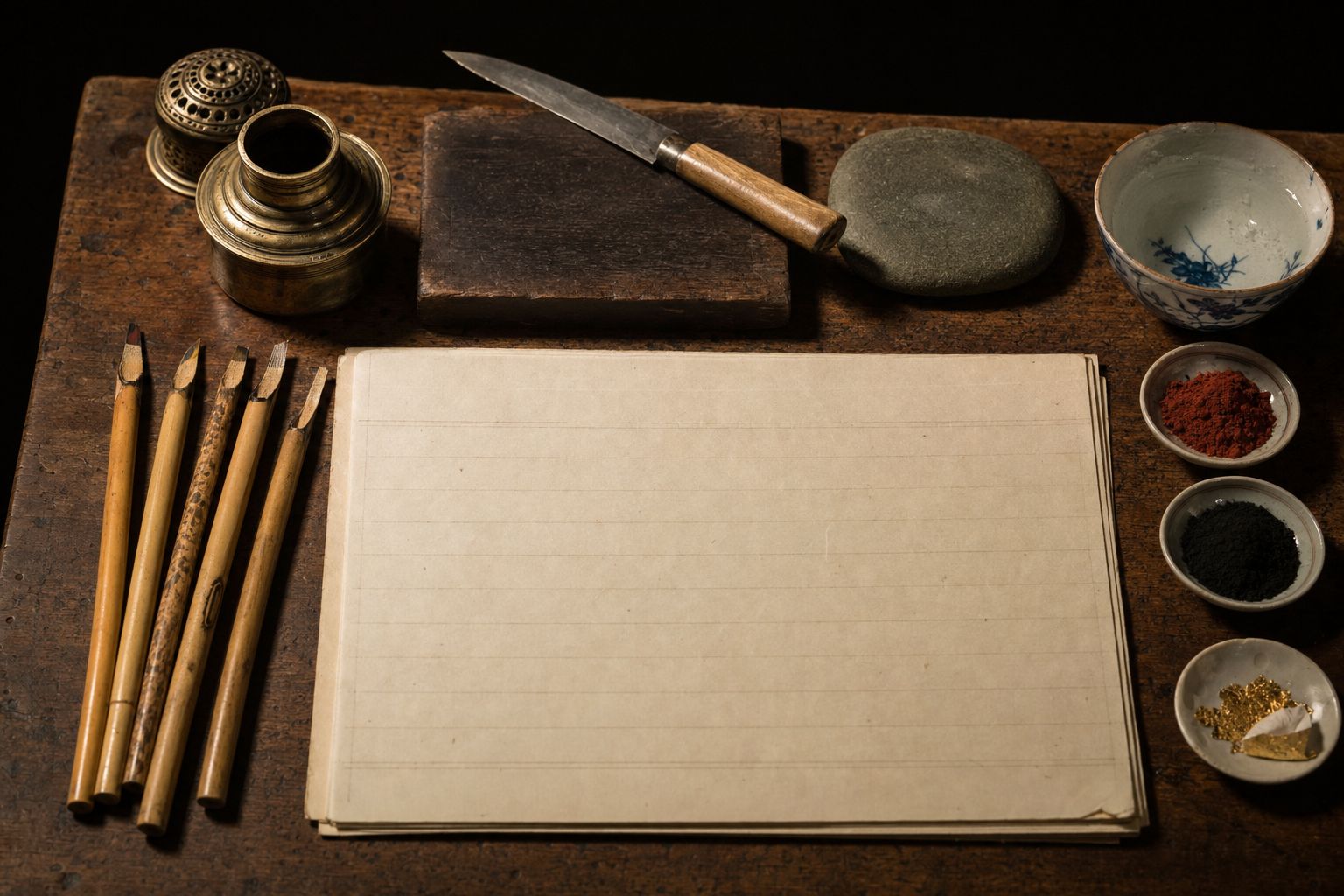
Most of the objects on this site are anonymous, which is normal for the period and easy to misread. Anonymity was not a lack of standing. Craftsmen were organised, paid, promoted and, in several trades, recorded by name in payroll registers that survive. What is missing is the modern habit of signing a finished work, and it is missing unevenly: metalworkers signed constantly, potters almost never.
Who actually gets named
| Name | Active | Trade | Known for |
|---|---|---|---|
| Bihzad | c. 1465-1535 | Painter | Herat manuscript painting at its height; later head of the royal library at Tabriz |
| Muhammad Siyah Qalam | uncertain, 14th-15th c. | Painter | Album drawings of nomads, demons and animals; almost nothing else is established |
| Mimar Sinan | 1489-1588 | Architect | Chief imperial architect for nearly fifty years; the Suleymaniye and the Selimiye |
| Sahkulu | d. 1556 | Court designer | Head of the palace design office; the saz style of feathery serrated leaves |
| Kara Memi | fl. 1540s-1560s | Illuminator | Pupil of Sahkulu; the naturalistic tulip, carnation and rose vocabulary |
| Ahmed Karahisari | 1468-1566 | Calligrapher | Monumental Qur'anic script; his hand is on imperial buildings and manuscripts |
| Matrakci Nasuh | d. 1564 | Painter and writer | Topographical views of cities along campaign routes, a genre of his own |
| Nakkas Osman | fl. 1560s-1590s | Painter | Head of the palace painting studio; the illustrated Ottoman court histories |
Sahkulu, Kara Memi and the invention of a style
Two names account for most of what a sixteenth-century Ottoman surface looks like. Sahkulu arrived in Istanbul from Tabriz and brought with him the saz idiom: long serrated leaves curling through composite blossoms, sometimes with dragons and mythical creatures half hidden in the foliage. It is a drawing style before it is a decorative one, and it was executed with a reed pen.
Kara Memi, his pupil, went the other way. He introduced flowers that are recognisably themselves: tulips, carnations, hyacinths, roses and spring blossom, arranged in sprays. Between them the two men supplied the vocabulary that Iznik potters, Bursa weavers and the imperial bookbinders all worked from for two generations.
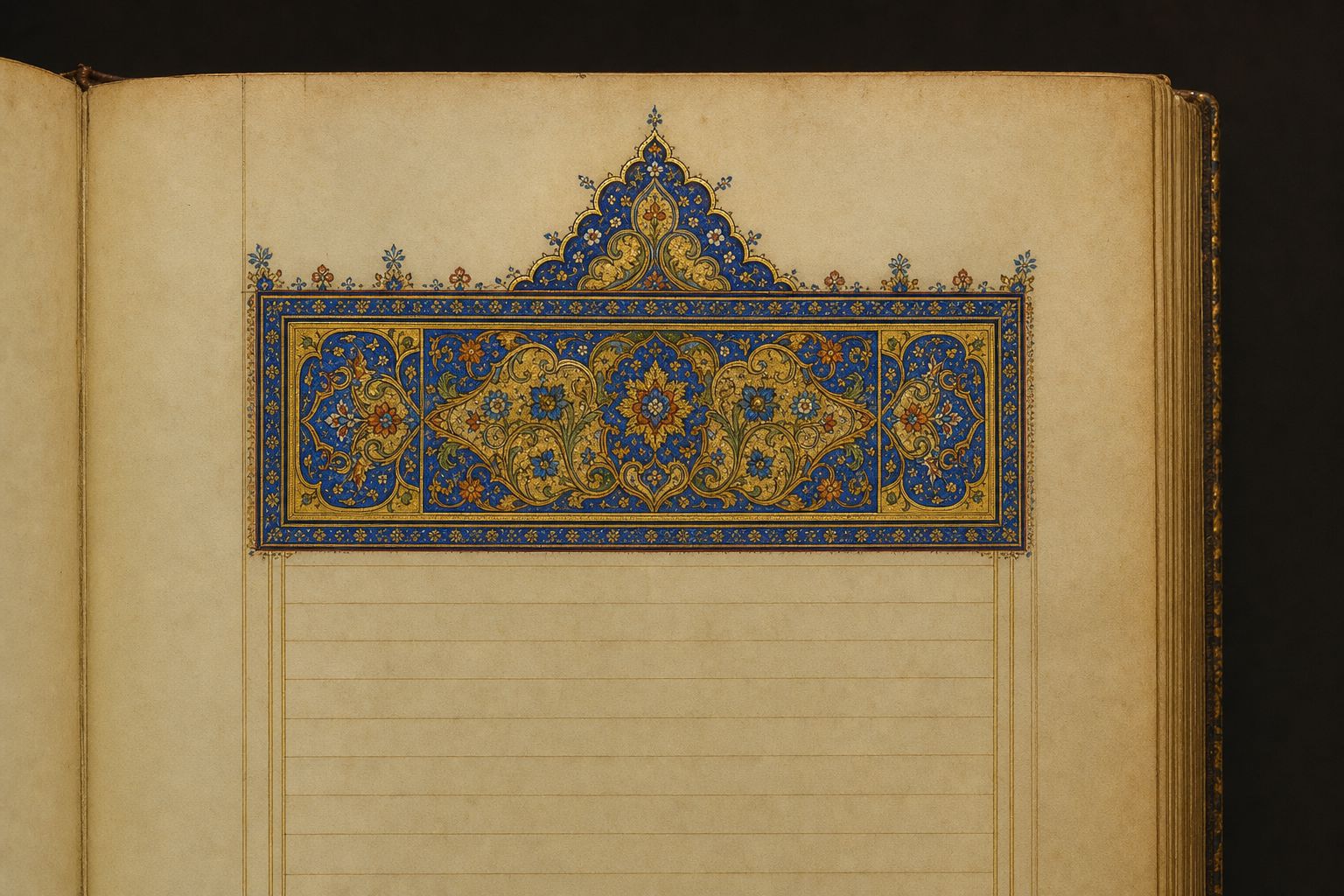
Calligraphy as a named profession
Calligraphers were the highest-status makers in this world, and the only ones with a formal chain of teaching that was tracked and recorded. A student received an ijaza, a licence to sign, from his master, and lineages were traced back through named hands over centuries.
Ahmed Karahisari is the sixteenth-century Ottoman figure. His large-scale Qur'anic inscriptions are the ones that run around the base of a dome, and the fact that we know his name while the tile-cutters who executed them are anonymous says something exact about the hierarchy of the trades.
The problem with Muhammad Siyah Qalam
The drawings attributed to Muhammad of the Black Pen sit in albums in Istanbul and belong to no comfortable category. They show nomads with their animals, shamans, and demons drawn with the same attention as the humans, on paper, in ink and colour, at a scale and with a directness that has no parallel in courtly manuscript painting.
Nothing about him is settled: not his dates, not his location, not whether the attribution covers one hand or several. He is included here precisely because he is the exception that shows how thin the biographical record actually is.
The workshops behind the names
Behind every name in the table is an establishment. The Ottoman nakkashane and the Timurid kitabkhana both employed dozens of people across several trades, and payroll registers list them by name, origin and wage. Some entries record craftsmen brought back from campaigns in Tabriz or Cairo.
That is the honest picture: a small number of documented individuals at the top of a large, organised, mostly unnamed workforce whose output is what fills the museums.
Common questions
Why are so few objects signed?
Signing varied by trade. Inlaid metalwork was signed frequently, often with a place of origin; ceramics almost never. Calligraphers and architects were named because their professions had formal status and documented lineages.
Who was Sahkulu?
Head of the Ottoman palace design office, who died in 1556. He brought the saz style of serrated leaves and composite blossoms from Tabriz to Istanbul.
What is a nakkashane?
The Ottoman court design office. Its designers produced patterns on paper that were then executed by tile, textile, metal and book workshops, which is why objects in different materials share the same drawings.
Are the Siyah Qalam drawings genuinely by one artist?
It is not established. The attribution covers a body of album drawings that may be the work of more than one hand, and neither the dates nor the place of production are secure.