Material culture
The Ottoman Table: Food, Coffee and the Vessels It Was Served In
Nothing survives of a meal except the vessels it was served in, the kitchens it was cooked in and the account books that record what was bought. Those three between them describe the Ottoman court more precisely than most chronicles, and they explain why a whole class of objects exists.
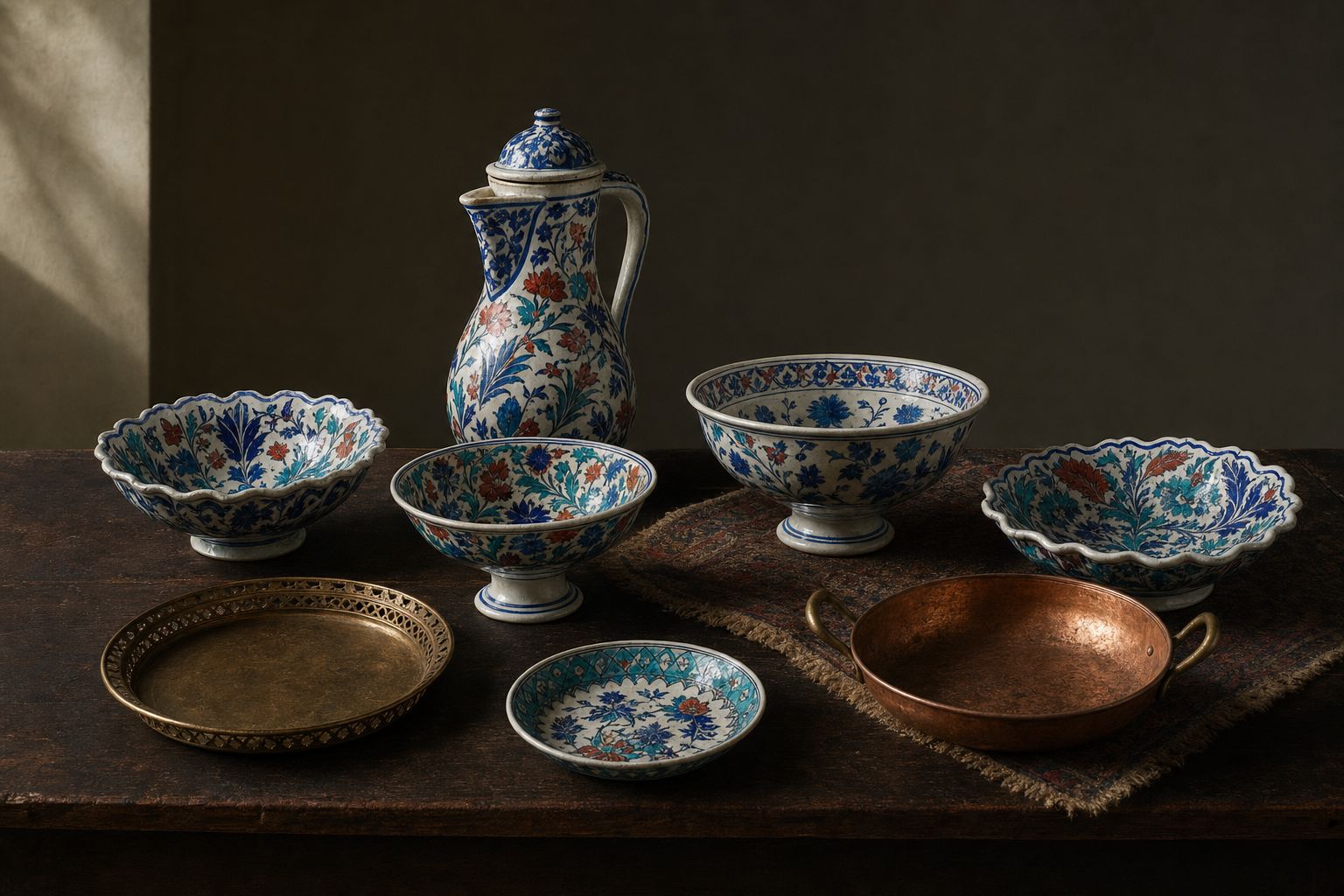
Food is the part of material culture that leaves the least behind and explains the most. Nothing survives of an Ottoman meal except the vessels it was served in, the kitchens it was cooked in and the account books that record what was bought, and those three between them describe the court more precisely than most chronicles.
The imperial kitchens
The kitchens at Topkapi occupy a whole courtyard of the palace and were rebuilt by Sinan after a fire in 1574. They were not one kitchen but a series of them, separated by function and by who was being fed: the sultan, the harem, the palace officers, the guard. At their height they employed several hundred staff and fed thousands of people daily.
The registers of the kitchens survive and are unusually detailed. They record quantities of rice, mutton, honey, butter, spices and ice, the prices paid and the suppliers. Ice was brought from the mountains of Bursa for sherbet. Sugar, still expensive, is recorded separately from honey.
What was actually eaten
The court diet was built on lamb and mutton, rice, wheat in several forms, pulses, and a great deal of fruit both fresh and dried. Dishes recognisable today appear in the sources: pilaf, borek, dolma, kebab, hosaf of stewed dried fruit, and the sweet pastes and helva that the palace confectioners produced in their own department.
Yoghurt and its savoury drink appear throughout, as they do in the earlier steppe diet, which is one of the few direct culinary continuities from Inner Asia. Aubergine, which later becomes almost emblematic, is well established by the sixteenth century.
A drink that made objects
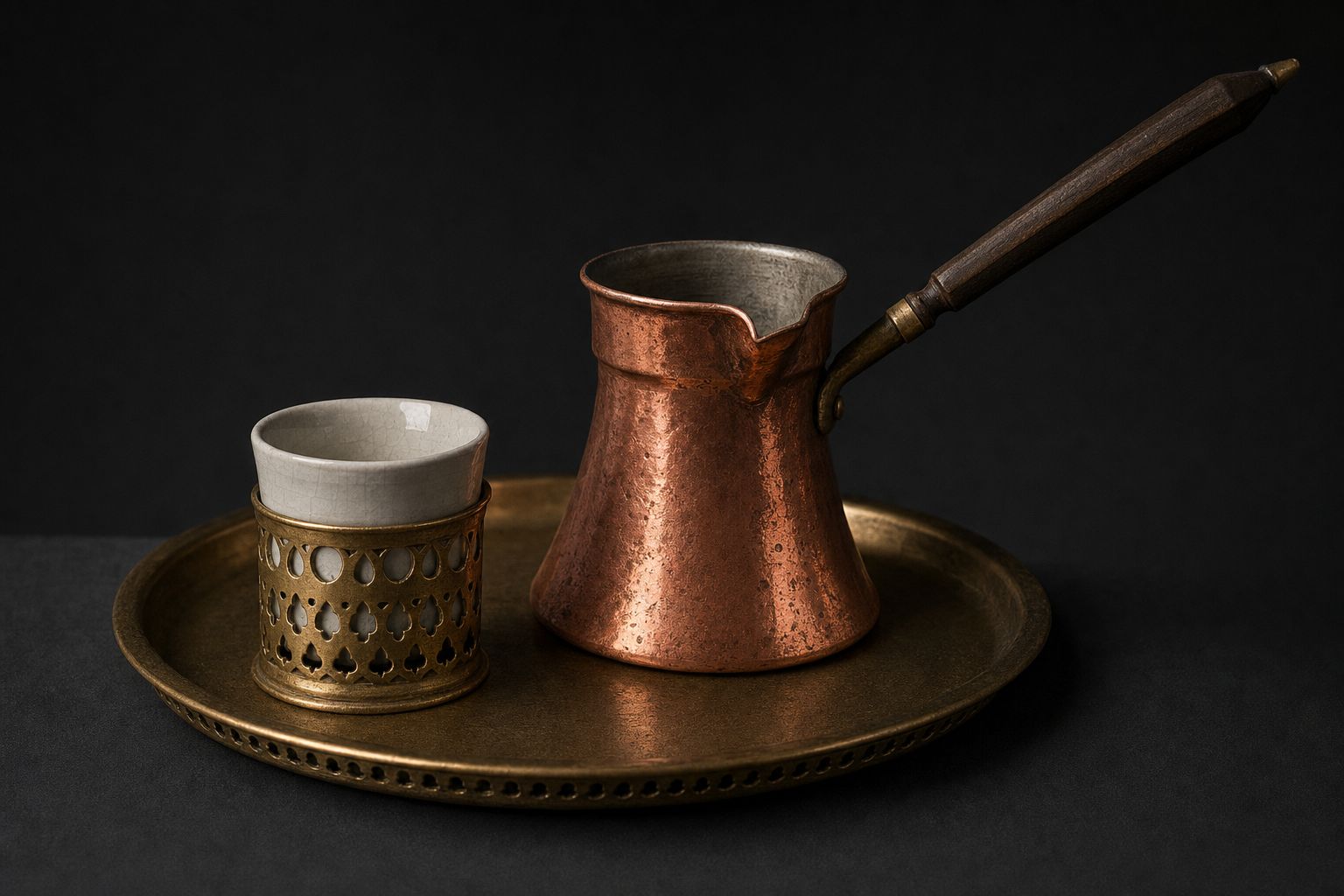
Coffee arrives from Yemen by way of Cairo and Damascus. Within a generation it has produced a whole class of vessels that did not exist in 1500: the handleless cup, the pierced holder, the long-handled pot.
Coffee, and what it changed
Coffee reaches Istanbul in the middle of the sixteenth century, from Yemen by way of Cairo and Damascus, and the first coffee houses in the city open in the 1550s. They were banned more than once, on the grounds that men gathered in them and talked, which is a fair summary of why they mattered.
The consequences for the objects are direct. A new drink needs new vessels: the small handleless cup, the metal holder that later becomes the zarf, the long-handled pot. An entire category of Ottoman metalwork and ceramics exists because of a habit that did not exist in 1500.
What the table was set with
| Vessel | Material | Use |
|---|---|---|
| Large dish | Iznik fritware | Communal serving; the form follows Chinese porcelain chargers |
| Footed bowl | Iznik fritware | Rice, stewed fruit, yoghurt |
| Tinned copper pan | Copper | Cooking and serving; tinning renewed by a specialist trade |
| Ewer and basin | Brass or ceramic | Washing hands before and after eating, at the table |
| Sherbet jug | Ceramic or glass | Chilled fruit syrups, sweetened and served cold |
| Coffee cup and holder | Ceramic, with metal zarf | From the mid sixteenth century onwards |
| Sofra tray | Tinned copper on a low stand | The table itself; diners sat around it on the floor |
Chinese porcelain at the Ottoman table
The Topkapi collection holds one of the largest groups of Chinese porcelain outside China, accumulated by the court over centuries. It was used as well as collected, and its presence explains a great deal about Iznik shapes and palettes: potters were working in a court that ate off the real thing.
Some pieces were mounted in gold and set with stones, which turns an imported functional object into a treasury item. The habit says something about how value worked at this court, where material, workmanship and rarity were weighed separately.
Eating as a matter of arrangement
Meals were served on a round tray set on a low stand, with diners seated around it. Dishes came one at a time rather than all together, and the sequence was ordered rather than free. Hands were washed at the table, from a ewer poured over a basin, which is why the ewer-and-basin set is one of the commonest survivals in Ottoman metalwork.
None of this is incidental to the art. The dish, the ewer, the tray and the cup are among the most numerous objects the period produced, and they were made to a standard because they were seen by guests.
Common questions
When did coffee reach Istanbul?
In the middle of the sixteenth century, from Yemen by way of Cairo and Damascus. The first coffee houses in the city opened in the 1550s.
What was the Ottoman table like?
A round tray on a low stand, with diners seated around it and dishes brought one at a time. Hands were washed at the table from a ewer poured over a basin.
Why is there so much Chinese porcelain at Topkapi?
The court collected and used it over centuries. Its presence directly shaped Iznik shapes and the taste for blue and white.
What survives of Ottoman food itself?
Nothing of the food. What survives is the vessels, the kitchen buildings and the palace account registers, which record quantities, prices and suppliers in detail.