Masterpieces
Masterpieces: Six Objects and the Thousand Years Behind Them
Objects that outlived the courts that made them, in six materials that each impose their own limits. Ceramic survives best and so dominates every collection; metal survives but loses its inlay and its polish; paper survives only where the climate is dry; textile barely survives at all. The shape of what is left is therefore a fact about chemistry before it is a fact about what anyone valued. These six were chosen because each one is legible: you can see how it was made, and each shows one recurring habit of the thousand years clearly enough to argue from.
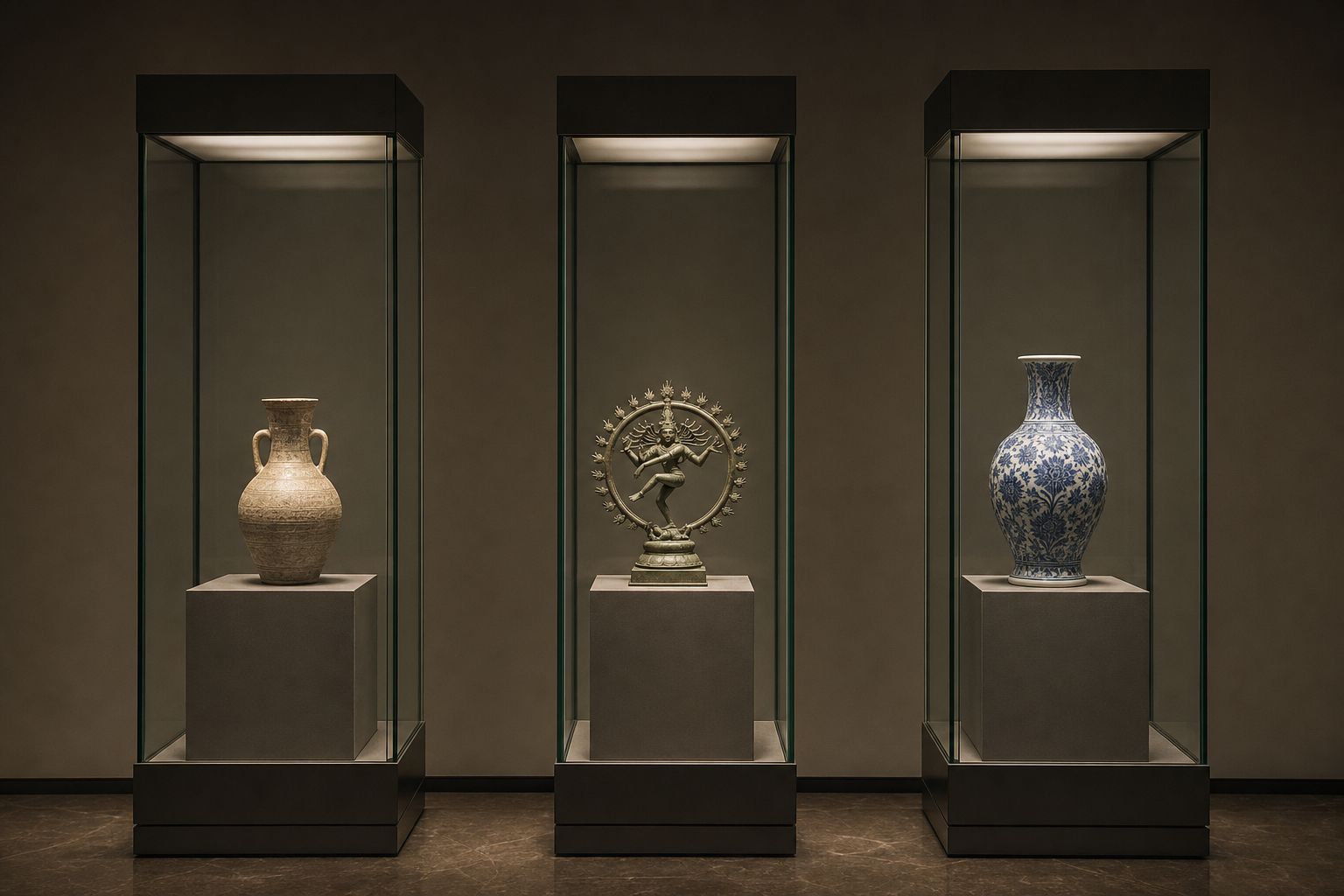
The display case
Six objects, lit one at a time
Choose an object from the rail. The case changes the way a case does: one thing at a time, with the light on it and the label beside it.
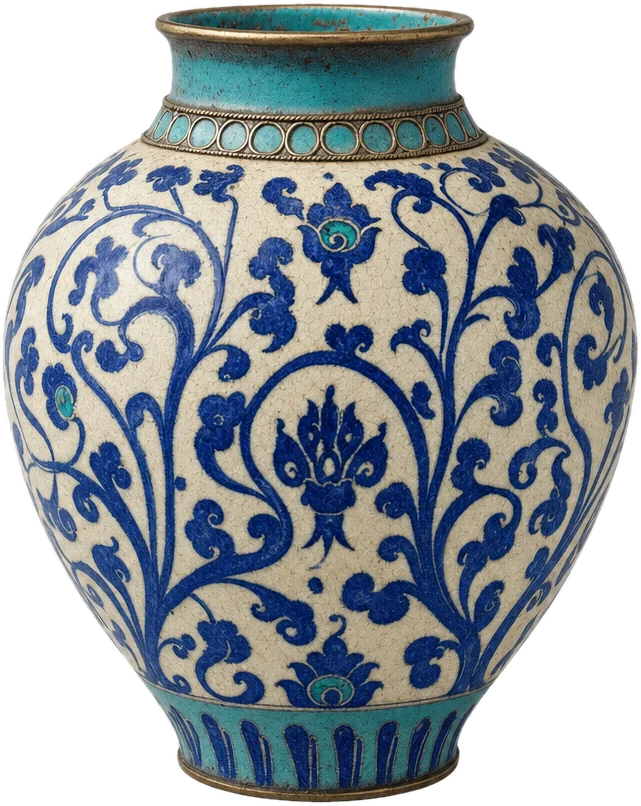
Blue-and-white ewer
fifteenth to sixteenth century
Cobalt under a clear alkaline glaze, painted with a scrolling vine that runs unbroken around the body and begins nowhere. The shape is borrowed from metalwork, strut and all; the decoration answers the Chinese porcelain arriving along the same routes, on a body of ground quartz that was the nearest thing to porcelain the region could fire.
View details →An object is harder to generalise about than a period, which is the main argument for putting these six at the centre of the site rather than at the end of it. Each one carries a technique, a trade route and a customer, and between them they cover most of what the thousand years actually produced.
What is here
Ceramic, steel, brass, bronze, silk and paper. Six materials, six different sets of hands, and six answers to the same question about what a surface is for.
How to read an object
Three questions get most of the way. What is it made of, and what does that material allow or forbid? Who was it made for, and how do you know? And what has changed about it since, because almost nothing here looks the way it did when it left the workshop. Silver inlay blackens or falls out, bronze corrodes green, glaze crazes, gold wears through, dyes shift.
The materials, in order of survival
Ceramic survives best, which is why it dominates every collection of this material. Metal survives well but loses its inlay and its polish. Paper survives only where the climate is dry. Textile barely survives at all, and what does is usually a fragment reused as something else. The shape of the surviving corpus is therefore a fact about chemistry rather than a fact about what was valued.
What the six do not cover
No architecture, because a building cannot be moved into a display case and needs its own section. No manuscript page as such, although the scroll is paper and the brocade shares its design vocabulary. And nothing from the earliest part of the period, because the belt fittings and horse gear of the steppe centuries are small, fragmentary and hard to read without a great deal of context.
The gaps are worth stating because a selection always argues something. Six legible objects in six materials make the case that this is one tradition working across trades. A different six, weighted towards the eighth and ninth centuries, would make the case that it is several traditions that happen to overlap. Both are defensible.
Why these were chosen
Not because they are the most spectacular. Because each one is legible: you can see how it was made, and each shows one of the recurring habits of this thousand years clearly enough to argue from. The ewer shows a form borrowed across materials. The scroll shows that the patterns were transmitted as method. The brocade shows an object functioning as currency. Between them they cover most of what needs explaining.
The six objects
Blue-and-white ewer
Ceramic - fifteenth to sixteenth century
Cobalt under a clear alkaline glaze, painted with a scrolling vine that runs unbroken around the body and begins nowhere. The shape is borrowed from metalwork, strut and all; the decoration answers the Chinese porcelain arriving along the same routes, on a body of ground quartz that was the nearest thing to porcelain the region could fire.
Ceremonial helmet
Steel and gold - sixteenth century
A parade piece rather than a battlefield one. The dome is raised from steel and fluted for stiffness, then chased with gold laid into cut grooves and hammered flush. What is missing is what made it wearable: the mail, the lining and the nasal bar are almost never preserved.
Inlaid bowl
Brass with silver inlay - thirteenth century
Silver wire hammered into undercut channels in the brass, locked in place by nothing but its own spread. The craft is traceable city by city, because metalworkers in this tradition signed their work more often than anyone else, and the signatures follow them from Herat to Mosul to Cairo.
Bronze mirror
Cast bronze - twelfth to thirteenth century
One face polished for use, the other cast in relief with a mounted hunter turning to shoot behind him. That image runs from Sasanian silver to Ottoman textiles carrying the same meaning throughout. The green is corrosion: the object was originally golden and bright.
Silk brocade
Silk and metal thread - sixteenth century
Large ogival medallions repeat down the length, filled with carnation and tulip. The repeat is a property of the loom, not a choice. Court textiles worked as currency: robes of honour were graded to the rank of the recipient, and the registers that record who received what survive better than the cloth does.
Geometric scroll
Ink on paper - fifteenth century
A working drawing, not an artwork: faint construction lines under a finished interlace, the record of how a builder generated a pattern from a divided circle. It proves the patterns travelled as method rather than as images, which is why the same geometry appears in tile, timber, stone and bookbinding.
Common questions
Why only six objects?
Because each one is legible: you can see how it was made, and each shows one recurring habit of the period clearly enough to argue from. A longer list would cover more ground and explain less.
Are these the objects from the 2005 exhibition?
These entries describe object types and techniques represented in that material. Specific historical works reproduced on this site are identified and credited where they appear.
Why is there so little textile?
Because almost none survives. Silk is worn out, eaten and faded, and metal thread was recovered by burning old cloth. The surviving corpus is shaped by chemistry, not by value.
What is the single most informative object type?
Arguably the tile panel, because it is usually fixed to a datable building, and much of the chronology of Islamic ceramics is anchored to architecture rather than the other way round.