Peoples and dynasties
The Ottoman Empire: A History of the Sultans and the Rise and Fall of a Court Style
From a frontier principality in Anatolia to an empire on three continents, and the design office that made it look like one thing. By 1600 the Ottoman court had done what none of its predecessors managed: a single vocabulary, issued centrally, executed consistently in ceramic, silk, metal, paper and stone from Hungary to Yemen.
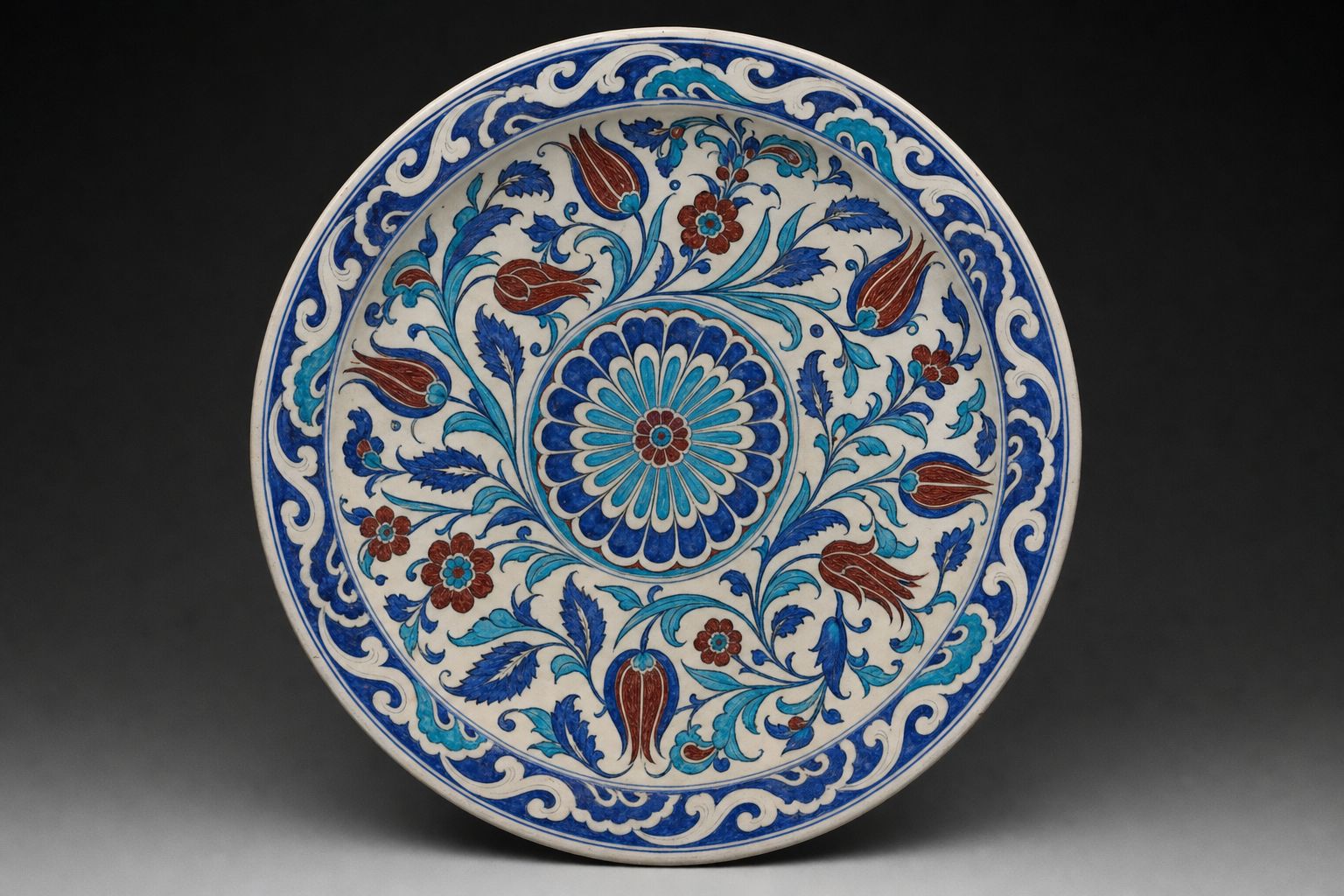
The Ottoman Empire is the end point of this thousand years and the reason the earlier parts of it are usually told as a run-up. That is unfair to the Uighurs and the Seljuks, but it is not entirely wrong. By 1600 the Ottoman court had achieved something none of its predecessors managed: a single design vocabulary, issued centrally, executed consistently in ceramic, silk, metal, paper and stone across an empire that stretched from Hungary to Yemen.
A short history of how the Ottoman Empire began
Around 1300 the Anatolian Seljuk sultanate dissolved into a dozen small principalities. One of them, on the Byzantine frontier in the north-west, was led by a chieftain named Osman. It had two advantages over its neighbours: a frontier to expand into, which the inland principalities did not, and a position on the routes into Europe.
The expansion was fast. Bursa fell in 1326, Edirne in 1361, and by the end of the fourteenth century Ottoman armies were operating in the Balkans as a matter of routine. Timur's defeat of Bayezid I at Ankara in 1402 nearly ended the state and did cost it a decade of civil war, which is a reminder that nothing in this history was inevitable.
The Ottoman sultans and the imperial turn
The sultans of the fifteenth and sixteenth centuries are the visible face of this, and the rise and fall of particular styles tracks their reigns closely. 1453 is the hinge. Mehmed II took Constantinople at the age of twenty-one, moved his capital there and began rebuilding it as an imperial centre rather than a captured city. He commissioned Italian painters and medallists, collected Greek and Latin manuscripts, and treated the Roman inheritance as something he had acquired rather than destroyed. The portrait tradition around Mehmed II comes out of that decision.
The sixteenth century under Selim I and then Suleyman took the empire to its greatest extent and, more importantly here, gave it its style. Selim's conquest of the Mamluk lands in 1517 brought Cairo, Damascus and the holy cities into the empire and with them their craft traditions. Suleyman's long reign, from 1520 to 1566, provided the stability and the money for a sustained building and furnishing programme.
The nakkashane and why Ottoman objects match each other
The mechanism behind Ottoman visual consistency was administrative. The court design office, the nakkashane, employed designers who produced patterns on paper. Those patterns were then sent out to be executed by the tile workshops at Iznik, the silk weavers at Bursa, the binders and illuminators of the palace and the imperial architects.
This is why a sixteenth-century Iznik dish and a mosque wall two hundred kilometres away can carry the same saz leaf: not because a potter copied a building, but because both were working from drawings issued by the same office. Very few pre-modern states organised design that way.
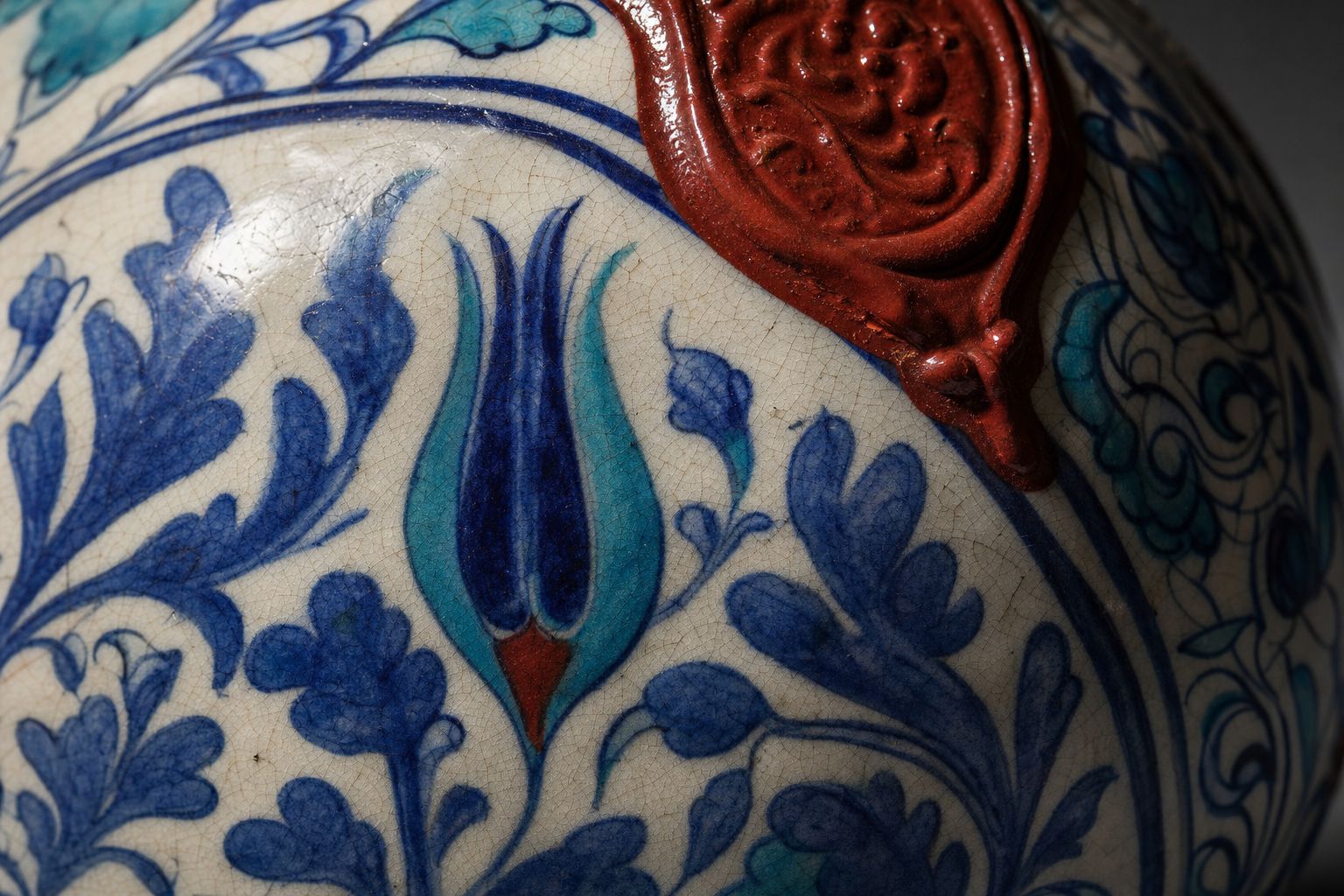
The vocabulary itself is small and endlessly recombined. The saz leaf, long, serrated and curving; the rosette; the tulip, carnation and hyacinth; and, from the middle of the century, a distinctive sealing-wax red that Iznik potters achieved by building the slip up in relief under the glaze.
Architecture as state policy
Ottoman architecture in this period is dominated by one office and effectively by one man. Sinan, chief imperial architect for nearly fifty years, worked through the problem of the domed space with the persistence of an engineer, and the mosques he built for Suleyman in Istanbul and for Selim II at Edirne are the resolution of it.
What is easy to miss is how much of the programme was not the mosque. A Sinan foundation is a complex: mosque, madrasa, soup kitchen, hospital, bath, tomb, sometimes a caravanserai. The building of it was a transfer of imperial revenue into urban infrastructure, and the endowment deeds that funded it are among the most detailed economic documents of the period.
The rise and fall of a single design language
The rise and fall of that arrangement is easier to date than the empire's own. Nothing collapses in 1600. The empire lasts another three centuries. But the tight relationship between court design office and workshop loosens, Iznik production declines in quality as the imperial orders thin out, and the coherence that makes sixteenth-century Ottoman material so recognisable is not maintained.
That is why this history stops there. The thousand years from the Orkhon inscriptions to the Selimiye at Edirne is a single argument about surface, pattern and geometry, carried west across a continent and elaborated at every stage. After 1600 the argument continues, but it is a different one.
The colour nobody could copy
Iznik potters achieved a sealing-wax red by building an iron-rich slip up in relief under the glaze. No rival workshop reproduced it, and when it degrades after 1600 the decline is as datable as the rise.
How Iznik worked
Iznik is a small town in north-western Anatolia, and for roughly a century it supplied an empire. The body is fritware: about eighty per cent ground quartz, with a little white clay and glass frit, which fires very white and very hard and takes a clear alkaline glaze.
The palette expands in datable steps, which is why Iznik is the backbone of the period's chronology. Blue and white only, to about 1520. Turquoise added in the 1520s. Sage green and purple through the 1530s and 1540s, the group usually called Damascus ware. Then, from about 1557, the sealing-wax red: an iron-rich slip applied thickly enough to stand up in relief under the glaze. No other workshop managed it, and it degrades after about 1600, which dates the decline as clearly as the rise.
Production was not free. The palace ordered tile by the panel for named buildings and paid by the piece, and when imperial commissions thinned in the seventeenth century the workshops had no market large enough to replace them.
The empire as an administrative machine
Three institutions did most of the work and all three shaped what got made. The devshirme levied boys from Christian villages in the Balkans, converted and trained them, and staffed the palace, the army and eventually the grand vizierate from them. Sinan came into imperial service that way.
The timar assigned the tax revenue of a district to a cavalryman in exchange for service, which kept a large army in the field without a large treasury. And the waqf, inherited from earlier Islamic practice, funded every mosque complex in this account, with deeds specifying the endowed villages, the staff and their wages down to the sweepers.
None of this is decoration for the art history. A tile panel exists because a foundation was endowed, the foundation was endowed because revenue was assigned, and the revenue was assigned because a campaign had brought a province in. The chain is short and it is documented.
Reading the Ottoman Empire through its objects
The written history of the Ottoman Empire is a history of campaigns, treaties and succession crises, and it is well served elsewhere. The objects tell a quieter story that the chronicles largely omit: who was employed, what was ordered, how far a drawing travelled before it was cut in stone, and how quickly a new colour spread once someone worked out how to fire it.
A dated tile panel is evidence of a workshop running at a particular moment. A silk with an imperial mark is evidence of a gift, and gifts in this period were diplomacy. An architect's endowment deed lists the wages of the men who laid the stone. Taken together they describe an administrative machine that happened to produce beautiful things, which is a more accurate picture of the sixteenth-century Ottoman court than any account built on battles alone.
Common questions
When did the Ottoman Empire begin and how long did it last?
Conventionally it begins around 1299 with Osman in north-western Anatolia and ends in 1922. This site covers only the first three centuries, to 1600, which is the period of the court style described here.
Who was the most important Ottoman sultan for art and architecture?
Two have the strongest claim. Mehmed II, for moving the capital to Constantinople and opening the court to Italian and Greek influence, and Suleyman, whose reign funded the Sinan building programme and the peak of Iznik production.
What is Iznik ware?
Fritware made at the Anatolian town of Iznik from the late fifteenth century, painted under a clear glaze. It supplied both the tile for imperial buildings and vessels for the court, working from patterns issued by the palace design office.
How did the Ottomans differ from the Seljuks?
In scale and in centralisation. The Seljuks ruled through regional commanders holding tax assignments, and their art varies accordingly from province to province. The Ottoman state controlled design centrally, which is why its objects match each other so closely.