Peoples and dynasties
Timurid Art and the Timurid Empire: Herat, Samarkand and Manuscript Painting
Between 1370 and 1500 two Central Asian cities ran the most productive design workshops in the Islamic world. Timurid art began at Samarkand as a concentration of captives; what the next generation did with it at Herat was organise painting, calligraphy, binding and illumination as connected trades, and the standard they set held in three later empires.
Featured themes
Five trades, one workshop
Timurid production is easiest to understand as a set of connected crafts rather than a style. These are the five that met on the same page.
Timurid art is the point in this thousand years where the making of beautiful things stops being a by-product of a court and becomes one of its organising activities. Between roughly 1370 and 1500 the courts at Samarkand and Herat ran design and production as a connected system, and the results set a standard that Safavid Iran, Mughal India and the Ottoman court all measured themselves against.
How the Timurid workshops were assembled
The origin is not edifying. Timur built his capital at Samarkand partly by deportation. Craftsmen from Damascus, Aleppo, Baghdad, Delhi and Shiraz were rounded up and moved there, and the concentration of skill that produced Timurid art was in the first instance the concentration of captives.
What his successors did with it was different. Shah Rukh at Herat, and after him Husayn Bayqara, turned the arrangement into an institution: the kitabkhana, literally the book house, which was a library, a design studio and a production workshop at once. Calligraphers, illuminators, painters, gilders, paper-makers and binders worked in the same establishment on the same commissions.
Timurid art on the page: manuscript painting and what changed in it
The single manuscript page is where Timurid art is most concentrated, and manuscript painting is the medium in which the period is usually judged. Earlier Persianate painting tends to place a few figures against a flat ground. Timurid painting fills the page: architecture with its facade removed so the interior is visible, gardens with every leaf articulated, crowds arranged in overlapping planes that read as depth without using perspective.
Colour is mineral and unmixed. Lapis blue, malachite, vermilion and gold are laid down flat and bright, and the picture holds together through drawing and pattern rather than through tone.
Bihzad, working at Herat at the end of the fifteenth century, is the name attached to the peak of it, though the attribution of individual pages to him is contested. What is not contested is that by 1500 a Herat painting was a recognised and portable prestige object, and that painters trained there carried the manner to Tabriz, Bukhara and eventually to the Mughal court at Agra.
Building at scale in Samarkand and Herat
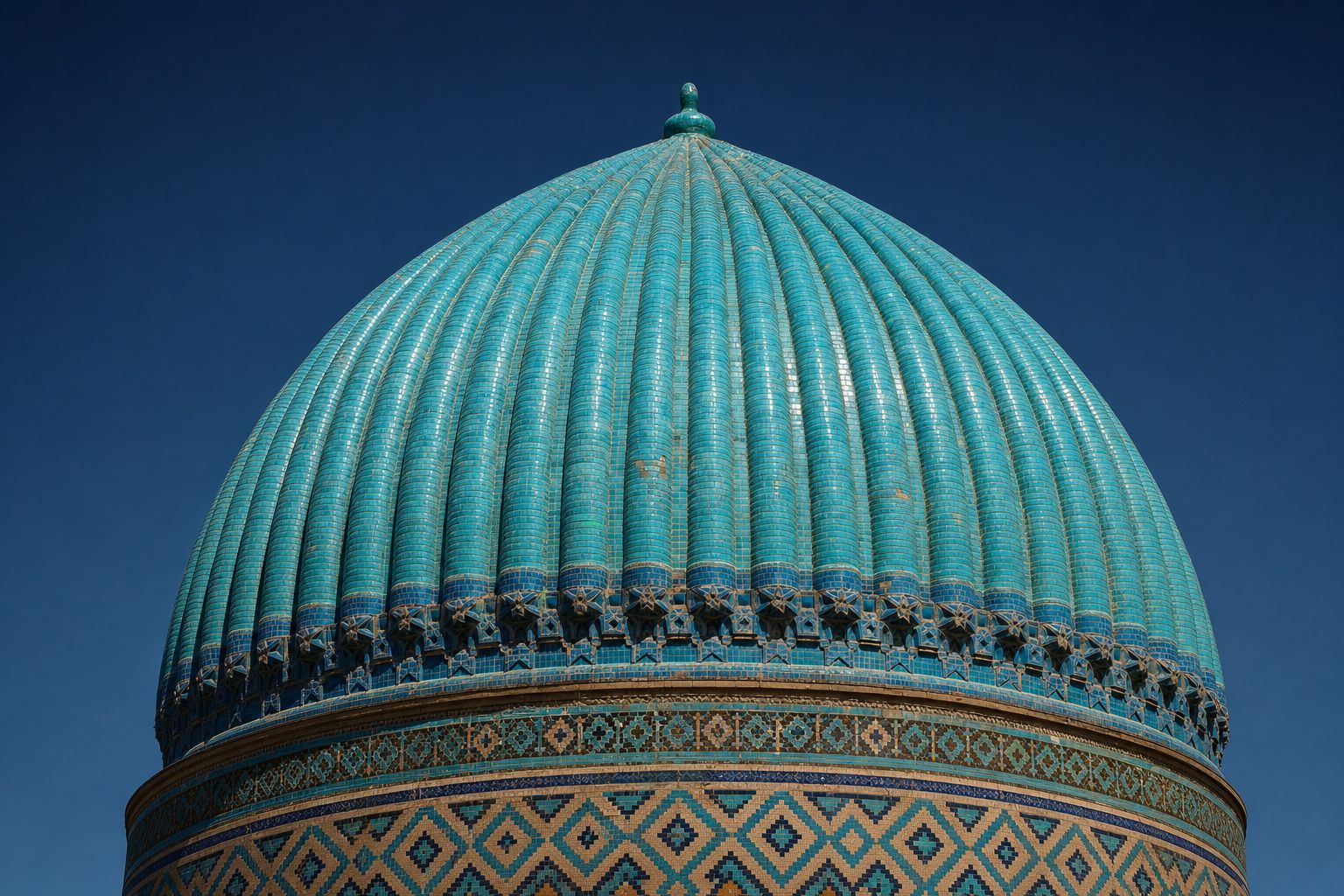
Timurid architecture is the loudest part of the output. The double-shell dome, an inner dome sized for the room and an outer one sized for the skyline, let builders raise very tall bulbous profiles without wrecking the interior proportions. The surfaces were then covered in glazed tile: cut mosaic faience for the fine work, larger painted tiles for the mass of it.
The Gur-i Amir in Samarkand, the Shah-i Zinda necropolis and the Bibi Khanum mosque are the standard examples. At Herat the surviving minarets of the Musalla complex give some sense of a scheme that has otherwise largely gone.
The tile is worth separating from the structure. Cut mosaic faience means every element of the pattern is a separately shaped and fired piece, set into plaster like a jigsaw. It is slow and expensive and it produces colour boundaries that painted tile cannot match. Where a Timurid building uses both, the mosaic is reserved for the surfaces a visitor sees close up and the painted tile carries the areas read from a distance, which is a budgeting decision as much as an aesthetic one.
Metal, ceramic and the flow of Chinese ideas
Timurid ceramics show something the earlier periods do not: sustained, deliberate engagement with Chinese blue-and-white porcelain, which arrived along routes the Mongol conquests had opened. Potters in Iran and Central Asia imitated the palette and then diverged from it, and the line runs directly from there to the Iznik wares of the sixteenth century.
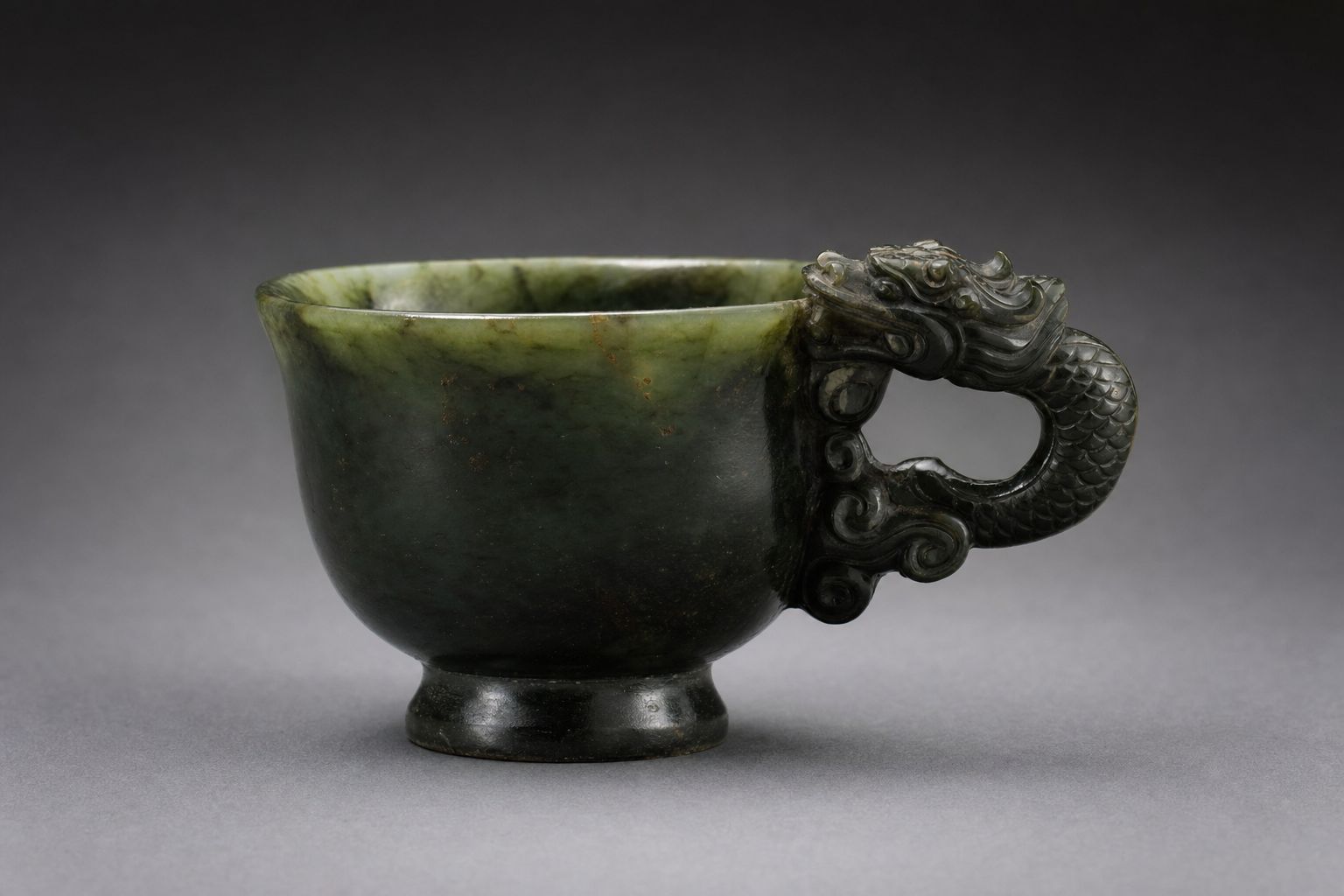
Jade, unusually, becomes a court material. Ulugh Beg's jade cup and the black jade cenotaph over Timur's grave are the conspicuous survivals, and both point east rather than west for their material and their finish.
Astronomy, mathematics and the same set of habits
The Timurid Empire funded science on the same terms as painting. Ulugh Beg, Timur's grandson, built an observatory at Samarkand with a sextant of forty metres radius and produced a star catalogue that remained the most accurate for two centuries. It belongs in an account of Timurid art rather than beside it, because the geometry in the tilework and the geometry in the instruments come from the same mathematical culture and often from the same people.
Lapis
Blue from one valley
Ultramarine came from lazurite mined in Badakhshan and was ground and washed repeatedly before it could be used. A single page of Timurid painting could carry pigment that had travelled two thousand kilometres.
How a manuscript was made
A single illustrated volume passed through at least six pairs of hands and often took years. The paper was made and burnished; the calligrapher ruled the page and wrote the text, leaving windows for the images; the illuminator painted the borders and headpieces in gold and lapis; the painter filled the windows; the gilder finished the margins; the binder assembled and stamped the covers.
Pigments were expensive and traded over long distances. Lapis lazuli came from Badakhshan, in what is now Afghanistan, and was ground and washed repeatedly to yield ultramarine. Gold was applied as shell gold, ground into a binder and painted on rather than laid as leaf, which is why Timurid gold has a soft rather than a mirror finish.
The result was a luxury object at the top of the court's scale of value. A finished copy of a poetic classic was a diplomatic gift on the level of a horse or a robe of honour, and the colophons record who paid, who wrote and, occasionally, how long it took.
Herat under Husayn Bayqara
The last three decades of the fifteenth century at Herat are the concentrated case. The sultan Husayn Bayqara ruled from 1469 to 1506, and his court held, at the same time, the poet and statesman Alisher Navoi, the poet Jami, the historian Khwandamir and the painter Bihzad.
Navoi matters beyond literature. He wrote in Chagatai Turkic and argued in print that it was a language fit for poetry against the prevailing assumption that serious verse belonged to Persian. He also endowed buildings on a large scale from his own fortune. The workshop culture at Herat was underwritten by exactly that combination: a ruler who paid, and a minister who both paid and wrote.
Fifteenth century
Ulugh Beg's observatory
At Samarkand in the 1420s Timur's grandson built an observatory whose principal instrument was a meridian arc of roughly forty metres radius, sunk into a trench cut in the rock so that it could be built large enough to be accurate. The surviving underground section was excavated in 1908 and can still be seen.
The catalogue produced there, the Zij-i Sultani, fixed the positions of over a thousand stars and gave the length of the sidereal year within about a minute of the modern value. It remained the most accurate available until Tycho Brahe, a century and a half later. Ulugh Beg was murdered in 1449 at the instigation of his own son, and the observatory was dismantled soon after.
What the Timurid Empire passed on
The Timurid Empire as a political structure fragmented in the early sixteenth century. Babur, a Timurid prince, lost Samarkand, took Kabul and then northern India, and founded the Mughal dynasty, which is why Mughal painting begins as a Timurid style with a different climate.
Timurid art therefore has an odd afterlife: the dynasty ends and the visual system it built keeps running in three separate empires at once. Very little else in this thousand years travelled that well.
Common questions
What is Timurid art?
The art produced under Timur and his successors between roughly 1370 and 1500, centred on Samarkand and Herat. It is best known for manuscript painting, tiled architecture and fine metalwork.
Who was Bihzad?
A painter working at Herat at the end of the fifteenth century, traditionally regarded as the finest of the Timurid manuscript painters, though attributions to his hand are debated.
What is a kitabkhana?
A court book house: library, design studio and production workshop combined, employing calligraphers, painters, illuminators, gilders and binders on the same commissions.
How does Timurid art relate to Mughal and Safavid art?
Directly. Painters trained in the Herat tradition moved to Tabriz under the Safavids, and Babur, who founded the Mughal dynasty, was himself a Timurid prince. Both later styles begin as continuations of it.